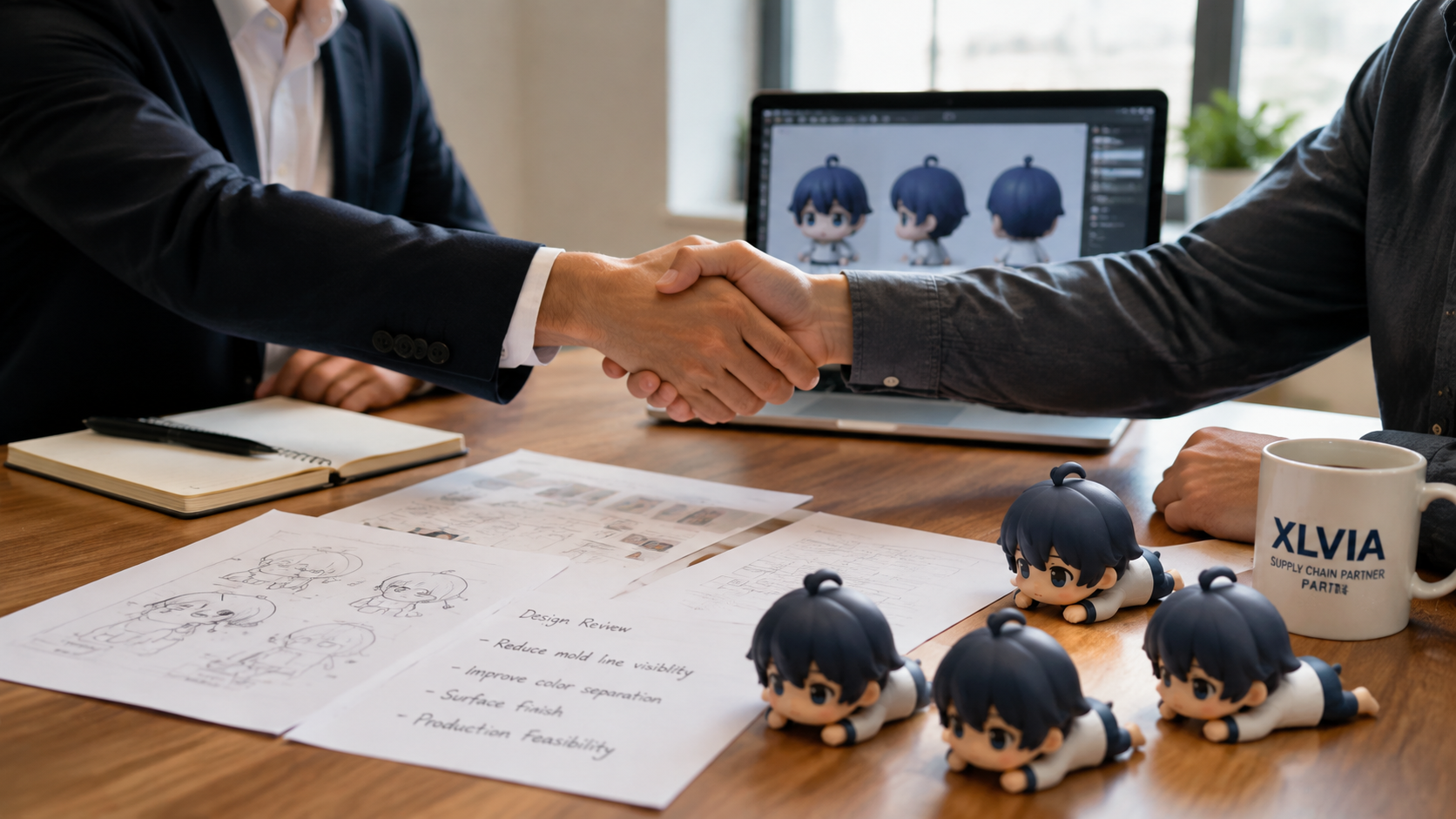
Sometimes a Project Starts with a Beautiful but Impractical Idea — Until We Sit Down and Make It Real
Client Background
We worked with a Japanese client who develops character-based merchandise.
For our first project together, the client wanted to create a custom PVC figure — a soft vinyl mini character designed to sit on computers, desks, or other flat surfaces using double-sided tape.
At the start, they only provided a 2D design drawing.
From the client's perspective, it was an exciting and creative concept. But from a manufacturing standpoint, the drawing was more of a sketch than a production-ready plan. Certain angles, structural details, and thickness variations made it difficult to mold in PVC.
The client had no prior experience in 3D modeling or product development. They didn't just need a factory — they needed a partner who could help translate their creative idea into a manufacturable product.
---
From Concept to Production-Ready Design
Instead of saying "it can't be done" or overpromising, we had detailed discussions with the client. We explained which design elements would cause production issues, why they would cause problems, and how we could improve them.
Based on our manufacturing experience, we adjusted the product structure and provided a revised 3D model for the client to review.
Our goal throughout the process was simple: preserve the original design intent as much as possible, while ensuring the product could be reliably mass-produced.
After four rounds of communication and revisions, we finalized the design and moved into sample production.
---
Challenge 1: Visible Mold Lines
After the first sample was made, we recorded a high-resolution video and sent it to the client for review.
The feedback was clear: the separation lines between different color areas were too visible and hurt the overall appearance.
In multi-color PVC molding, these lines are common — they prevent color bleeding between adjacent areas. But for this character product, the client wanted a cleaner, more collectible look, and the visible lines were a dealbreaker.
---
Solution: Manual Polishing
We brought in our engineering team to analyze the problem. After discussion, they decided to improve the mold by manually polishing the parting edges.
The technician spent an entire day carefully grinding down the edges — just fractions of a millimeter at a time — to make the lines thinner and less noticeable while keeping the structure stable.
A new sample was produced and presented via high-resolution 360° video.
The client approved the improvement and asked us to ship the physical sample to Japan for final confirmation.
---
Building Trust: From One Design to Thirteen
After receiving and inspecting the sample, the client was very satisfied with the quality.
Shortly after, they placed an order for 13 additional designs in the same product series.
But there was a new challenge: all products had to be delivered within one month to meet an exhibition schedule in Japan.
Normally, this type of project takes at least 6–8 weeks — including 3D modeling, mold development, sampling, approval, and production.
But this was a client who had already trusted us. We couldn't let them down.
---
Challenge 2: Delivering 13 Designs in One Month
To meet the deadline, we launched a parallel production workflow.
3D modeling, production evaluation, and mold development for all 13 designs moved forward simultaneously. Instead of waiting for one step to finish before starting the next, we coordinated multiple stages at once.
To save international shipping time, we also streamlined the sample approval process.
Instead of shipping every sample to Japan and waiting for feedback, we used high-resolution video walkthroughs.
The client could review each product remotely:
· Detail close-ups
· Color accuracy
· Surface finish
· 360° views
...and provide comments quickly.
This approach saved us nearly two weeks of shipping back-and-forth.
---
Challenge 3: Adhesive Tape and Individual Packaging
Midway through production, the client added two more requirements:
1. Each figure needed a piece of strong double-sided tape attached to the back for end-user use.
2. Each figure needed individual packaging in a custom-printed box with the client's branding.
These requirements were not part of the original plan.
Our PVC factory didn't produce adhesive tape, and packaging boxes required a separate supply chain.
We quickly reached out to other trusted suppliers and coordinated three separate production streams: PVC figurines, adhesive tape, and custom packaging boxes.
---
Final Delivery
We delivered on all fronts:
· Manufactured all PVC figurines
· Sourced and applied double-sided tape
· Produced custom packaging boxes
· Assembled and inspected every unit
· Shipped on time
The client received the products before the exhibition.
More importantly, this project laid the foundation for a long-term partnership.
---
What This Project Taught Us
1. Great designs need manufacturing expertise.
A beautiful drawing is only the beginning. A successful product requires a balance between creative vision and production reality.
2. Small projects can build big trust.
The first order was just one design. But by solving quality issues properly, we earned the client's trust for 13 more.
3. Our real value is supply chain coordination.
We don't own a factory. But we know how to bring multiple suppliers together and synchronize their timelines into one smooth delivery. That's what we bring to the table.
---
Conclusion
At XLVIA, we don't promise miracles.
But when you bring us a challenge, we bring honest communication, coordinated execution, and a commitment to making it work.